
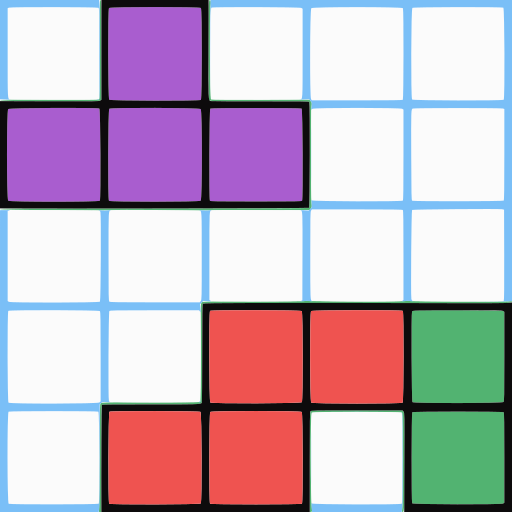
What Tetris is
Tetris is a falling-block puzzle from the 1980s. Pieces made of four squares, called tetrominoes, drop into a narrow well one at a time. You slide and turn each one as it falls, trying to build solid horizontal rows. A completed row vanishes and everything above it shifts down, which buys you room. If the stack grows so high that a new piece has no space to appear, the game is over.
The appeal is that nothing is ever finished. The pieces never stop coming, so you are always balancing the current piece against the shape of the pile you are building.
How to play
- A piece appears at the top and starts falling. There are seven shapes: the straight line, the square, the T, the L, the mirrored L (J), and the two zig-zags (S and Z).
- Move the piece left or right to line it up with the spot you want.
- Rotate it so its shape fits that spot.
- Let it fall, or push it down faster if the game lets you, until it lands on the floor or on the pile.
- When every square in a row is filled, that row clears. Clearing several rows with one piece earns more than clearing them one at a time.
- Keep the stack below the top. The game ends when a new piece cannot enter.
Beginner tips
- Keep the surface flat. A flat, even top gives every piece somewhere to go. Bumps and steep steps limit your choices.
- Avoid holes. A hole is an empty square buried under a filled one. Until you clear everything above it, that row cannot complete.
- Look at the shape of the gap before you choose a rotation. A piece in the wrong orientation is the most common cause of a hole.
- Do not rush rows. Clearing a single row immediately matters less than leaving a clean surface for the next piece.
- Watch the stack, not only the falling piece. Glance at the height of the pile before each placement so it never surprises you.
Strategy to improve
Build with a plan. Fill rows from the bottom up, and keep the heights of neighboring columns within one or two squares of each other. Fewer steep cliffs means fewer awkward pieces.
Keep a well for the long piece. A common technique is to leave one column, often at an edge, empty while you stack the rest tightly. When a straight line arrives, drop it into the well and clear up to four rows at once. This is usually the best way to score, but it requires a flat, hole-free stack beside it.
Know what each piece fits. The square wants a two-wide flat spot. The S and Z pieces suit a one-step height difference. The T is the most flexible and can fill a notch or finish a row. The L and J pieces fit corners and the end of a step.
Play for the odds, not the dream piece. If pieces come at random, you can get the same shape several times in a row, or wait a long time for a straight line. A stack that works with any piece survives these streaks, and a stack that needs one specific piece does not.
Stay calm as speed rises. Fast play makes you hurry, and hurrying makes holes. Decide where a piece goes the moment it appears, not halfway down. If you like planning against a growing board, the 2048 guide shares much of the same mindset.
Common mistakes
- Building tall in the middle and leaving deep, narrow valleys on the sides.
- Waiting for a straight line and stacking recklessly while you wait.
- Rotating a piece against a wall or another block without checking that the rotated shape fits.
- Covering a gap just to get rid of a piece, and creating a hole.
- Letting the stack climb into the top third of the well, where one bad piece ends the run.
Playing Tetris in Gaming Room
Controls
Four buttons sit under the board: left, rotate, right and a down arrow. There is no swipe control. Left and right slide the falling piece one column, rotate turns it a quarter turn each press, and the down arrow drops it straight to the lowest spot it can reach. There is no gentle one-row nudge.
Board and speed
The board is 10 columns wide and 15 rows tall, and pieces appear near the middle of the top. The seven classic shapes come up at random. There is no next-piece preview, no hold and no levels, so you plan around what is on the board. The falling speed is set from the ⋯ menu: Easy takes a step every 0.7 seconds, Normal every 0.5 and Hard every 0.2. Pieces speed up as your score rises, to a limit of one step every 0.1 seconds.
Scoring
Points come only from clearing rows: 10 for one row, 25 for two, 50 for three and 100 for four at once.
Menus and restarting
Choosing Easy, Normal or Hard from the ⋯ menu always starts a new game at that speed. If a game is in progress, the app asks "Give up the current game?" first. There is no separate restart button, so this menu is also how you start over.
When it ends
The game ends when a new piece has no room to appear. A result screen shows your score; its OK button appears after about 5 seconds, and closing it may bring up a full-screen ad. Leave a game and come back, and it resumes. Nothing is saved to your device: no high scores or history, and closing the app discards the game.
Frequently asked questions
Does Tetris in Gaming Room show the next piece or have a hold?
No. The app has no next-piece preview, no hold and no levels. You only see the piece that is falling and the stack on the board, so you plan from the stack's shape.
How do I change the difficulty?
Open the menu with the three dots in the top corner and choose Easy, Normal or Hard. This sets the falling speed and starts a new game, and the app asks you to confirm if a game is in progress.
How is the score calculated?
Only cleared rows score: 10 points for one row, 25 for two, 50 for three and 100 for four at once. Moving or dropping a piece adds nothing, and the pieces fall faster as your score grows.
What does the down arrow button do?
It sends the falling piece straight down to the lowest position it can reach. There is no slow, one-row-at-a-time version, so use it when you are sure about the column and rotation.
Does the app save my high score?
No. Nothing is saved to your device, so there are no high scores or history. An unfinished game resumes if you leave the screen and return, but closing the app discards it.
Written by Casa do Zéps and checked against the current version of the app. Game names such as Pacman, Tetris and Wordle are trademarks of their respective owners and are used here only to describe familiar kinds of game. Gaming Room is an independent app and is not affiliated with or endorsed by them.
 Pacman
 Sudoku
 2048
 MineSweeper
 Solitaire
 Peg Solitaire
 Labyrinth
 15-Puzzle
 Wordle
 Snake
 Memory Game