
What Peg Solitaire is
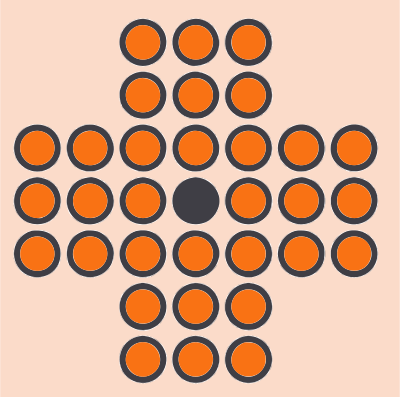
Peg Solitaire is played on a cross-shaped board with 33 holes. The classic version, often called the English board, has a peg in every hole except the center, so you begin with 32 pegs and one gap. There are no opponents and no dice. Every position is fully visible, so the game is pure planning.
The aim is to remove pegs by jumping until only one remains. Because each jump removes exactly one peg, finishing from the starting position takes exactly 31 jumps. A harder, traditional goal is to make that last peg end up in the center hole.
How to play
- Pick a peg that has another peg directly beside it and an empty hole right behind that peg, in a straight line.
- Jump over the neighboring peg and land in the empty hole.
- Remove the peg you jumped over from the board. If three holes in a row read peg, peg, empty, they read empty, empty, peg after the jump.
- Jumps go along rows and columns only. Diagonal jumps are not allowed.
- Keep jumping until no jump is left. One peg is a perfect result, and fewer pegs is always better than more.
Beginner tips
- Your first move is almost forced. From the standard start, only four first jumps exist, and they are all the same move rotated around the board. Do not spend time choosing.
- Think in groups of three. Peg, peg, hole is what every jump needs. A good move often creates the next one.
- Keep your pegs connected. A peg with no neighbors cannot jump and cannot be jumped, so it is stuck for good.
- Watch the ends of the arms. Pegs on the outer squares of the cross have the fewest options. Do not leave them for last without a plan.
- Take it slowly. There is no clock, and a move you cannot reverse deserves a moment of thought.
- Expect to miss at first. Finishing with four or five pegs is normal on early attempts. A single peg takes practice, so treat each game as a lesson in which patterns strand pegs.
Strategy to improve
Most lost games are decided long before they end. When you finish with three or four pegs scattered around the board, the mistake was usually made four or five jumps earlier, when a peg was left alone.
- Use the symmetry. The cross looks the same when rotated or mirrored, so a sequence that clears one arm can be repeated on another. Learning one good sequence pays off four times.
- Clear the board in sections. Try to empty one arm of the cross completely, in a way that leaves the pegs around it still connected, and then deal with the next one.
- Plan the ending early. Look at the last five or six jumps while you still have a choice. Near the end, the position of the final two or three pegs decides everything.
- Learn from repeats. Because the starting position never changes, you can repeat the same opening and try a different second or third move. This is the quickest way to understand the board.
- Try the center finish. Once you can reach one peg reliably, make it your next goal to finish in the center, where the game started empty. It is a tougher test of the same planning.
The same habit of looking several steps ahead before a move you cannot take back also helps in the 15-Puzzle.
Common mistakes
- Jumping at random early on. This is the quickest way to leave lone pegs on the arms.
- Emptying the middle while the arms are still full. Pegs on the arms then have nothing to jump over and get stranded.
- Leaving pegs on the outer squares with no neighbors.
- Not looking ahead at the end. The last few jumps need planning, not reflexes.
- Giving up on a position too early. If the game offers a restart, use it as a chance to try a different order of jumps.
Playing Peg Solitaire in Gaming Room
Controls
You play by dragging. Press a peg, drag it over a neighboring peg and drop it on the empty hole behind it. While your finger is over a hole, that hole turns green if the jump is legal and red if it is not. A legal jump removes the peg you jumped over. Each drag is one jump, in a straight line along a row or column.
The Restart button above the board starts a new game, and it asks you to confirm if one is in progress. The question-mark icon next to it shows a short help text. There is no menu in the app bar, and there is no undo, so a jump cannot be taken back.
The board
Gaming Room has only the classic 33-hole board, and every game starts the same way: 32 pegs with the center hole empty. There are no other layouts or difficulty levels.
How a game ends
The game ends by itself as soon as no legal jump remains. If exactly one peg is left, you win, and it does not matter where that peg sits. Finishing in the center is an extra goal you can set yourself. If more pegs are left, the result screen says you lost and shows how many pegs remain, which is a handy score to beat next time. The result screen opens after a short pause, its OK button appears after about five seconds, and a full-screen ad may appear when you close it.
Leaving and coming back
If you leave an unfinished game and return while the app is open, the board is exactly as you left it. Nothing is saved to your device: there are no high scores and no history, and closing the app discards the game in progress.
Frequently asked questions
How do I make a move in Gaming Room?
Drag a peg over a neighboring peg and drop it on the empty hole behind it. The target hole turns green when the jump is legal and red when it is not.
Does Gaming Room have undo or other boards?
No. There is only the classic 33-hole board, and a jump cannot be undone. The Restart button starts a fresh game, with a confirmation if one is in progress.
Do I have to finish in the center to win?
Not in Gaming Room. Exactly one peg left anywhere on the board counts as a win. Finishing in the center is the traditional extra challenge, but the app does not require it.
Can the puzzle always be solved?
From the standard starting position, yes: a one-peg finish exists. From a position you have already played into, it may no longer be possible.
Can pegs jump diagonally?
No. Jumps go only along rows and columns, one peg at a time. In Gaming Room, a drop on a diagonal hole is rejected.
Written by Casa do Zéps and checked against the current version of the app. Game names such as Pacman, Tetris and Wordle are trademarks of their respective owners and are used here only to describe familiar kinds of game. Gaming Room is an independent app and is not affiliated with or endorsed by them.
 Pacman
 Tetris
 Sudoku
 2048
 MineSweeper
 Solitaire
 Labyrinth
 15-Puzzle
 Wordle
 Snake
 Memory Game