
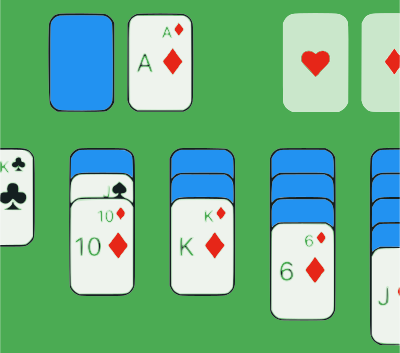
What Solitaire is
Solitaire here means Klondike, the version most people have in mind. It uses one standard 52-card deck and no opponents. The goal is to move every card onto four foundation piles, one per suit, each built upward from Ace to King.
The table has three parts. The tableau is seven columns dealt with one card in the first, two in the second, up to seven in the last. Only the top card of each column is face up. The stock holds the 24 cards left over. The four foundations start empty.
How to play
- Build down on the tableau in alternating colors. A red 6 goes on a black 7, and a black 5 can then go on that red 6.
- Move runs. A sequence of face-up cards that is built correctly can move as a group onto a card it fits.
- When you move the last face-up card out of a column, the card beneath it turns face up.
- Start each foundation with its Ace, then add the 2 of the same suit, then the 3, and so on up to the King.
- In the traditional rules, only a King, or a run that starts with a King, may go into an empty column.
- When no useful move is left on the table, draw from the stock. You turn over one card at a time in the version described here, and the top card of the waste pile is playable. When the stock runs out, the waste is turned back over to form a new stock. Some rule sets limit how many times you can do this.
- You win when all 52 cards are on the foundations.
Beginner tips
- Look at the whole table before you draw. A move available now may not be available after you turn a card from the stock, so check everything first.
- Prefer moves that flip a face-down card. Every new card means more options.
- Work on the column with the most hidden cards first. That is where your problem cards are buried.
- Send Aces and 2s to the foundations at once. They are almost never useful on the tableau.
- Remember what you have seen. Cycling the stock shows you every card in it, so you know what is coming and can plan around it.
Strategy to improve
The central idea is to keep your options open. When two moves are possible, choose the one that uncovers a hidden card or leaves another move still available.
- Choose between same-rank cards deliberately. If a red 6 fits on either of two black 7s, keep it off the column with the most hidden cards. That is the column you will want to dig into first, and a pile of cards on top makes it harder.
- Do not rush cards upward. Once a card is on a foundation, it can no longer receive cards on the tableau. Keep the foundations roughly even, so a 5 that is still needed as a landing spot is not stranded there.
- Empty a column only with a plan. Under standard rules an empty column needs a King. Clearing one with no King available just creates a space you cannot use.
- Shift runs with a purpose. Move a run when it reveals a card, empties a column or unlocks a foundation move, not just to rearrange.
If you like this style of patient planning, Peg Solitaire rewards the same habit of thinking several moves ahead.
Common mistakes
- Cycling the stock without rechecking the table. Every draw can open a move that was not there before.
- Moving cards to the foundations too early. This removes cards you needed to build on.
- Emptying a column when no King is available.
- Burying a needed card. Dropping a card onto a column can block a more useful move later.
- Blaming yourself for every lost deal. Some random Klondike deals cannot be won with any play, so a lost game is not always a mistake.
Playing Solitaire in Gaming Room
Controls
You play by dragging; the only tap is on the stock. Tap the stock at the top left to turn one card onto the waste pile beside it. When the stock is empty, tap its faded outline to turn the waste back over. Passes are unlimited.
Drag any face-up card to move it. Dragging a card in a column takes every card below it along. You can also drag the top card of the waste. Face-down cards flip automatically when uncovered. The four foundation slots at the top right are fixed to hearts, diamonds, spades and clubs, each starting with the Ace. Move cards to the foundations one at a time. A foundation card can be dragged back onto a column. There is no undo, hint or tap-to-move.
Rules in this version
The app deals Klondike and draws one card at a time. It is more relaxed than the traditional rule: any card can go into an empty column, not only a King. If you want the traditional challenge, hold yourself to Kings only.
New games and endings
The New Game button above the table starts a fresh deal, asking you to confirm if a game is in progress. The question-mark icon beside it shows a short help text.
You win when all 52 cards are on the foundations. There is no loss state and the app never says you are stuck, so use New Game when you decide a deal is done. The result screen's OK button appears after about five seconds, and a full-screen ad may appear when you close it.
Leaving and coming back
An unfinished game resumes if you return while the app is open. Nothing is saved to your device: no high scores, no history, and closing the app discards the game.
Frequently asked questions
Can every deal be won?
No. Some random Klondike deals cannot be won however well you play, so a lost game is not always a mistake. Gaming Room deals randomly and does not check whether a deal is winnable.
How do I move cards in Gaming Room?
Drag them. Drag a face-up card, or a card in a column together with the cards beneath it, onto a column or foundation. The only tap is on the stock pile, which turns one card at a time.
Does Gaming Room let me undo a move or get a hint?
No. The game has no undo, no hint and no tap-to-move. Each drop is final, so check the move before you release the card.
Can I put any card in an empty column?
In the standard rules only a King may go there. Gaming Room is more relaxed and accepts any card in an empty column, which makes the game a bit easier.
What is the difference between drawing one card and three?
Drawing three is harder because you cannot reach every card on each pass. Gaming Room draws one card at a time and lets you go through the stock as many times as you like.
Written by Casa do Zéps and checked against the current version of the app. Game names such as Pacman, Tetris and Wordle are trademarks of their respective owners and are used here only to describe familiar kinds of game. Gaming Room is an independent app and is not affiliated with or endorsed by them.
 Pacman
 Tetris
 Sudoku
 2048
 MineSweeper
 Peg Solitaire
 Labyrinth
 15-Puzzle
 Wordle
 Snake
 Memory Game