
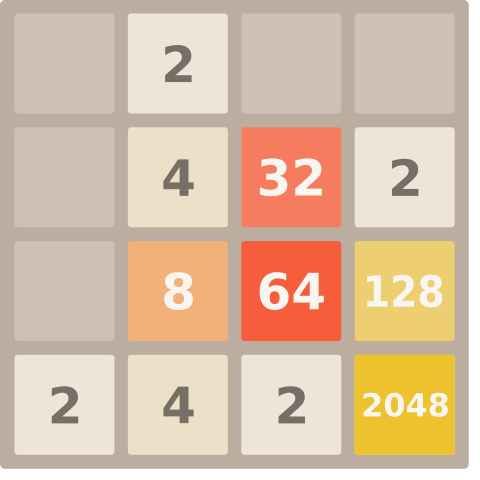
What 2048 is
The board is a 4x4 grid holding numbered tiles. Each move slides every tile as far as it can go in the direction you choose. When two tiles with the same number collide, they merge into one tile with their sum: 2 and 2 make 4, 4 and 4 make 8, and so on up to 2048. After each move that changes the board, a new small tile appears in a random empty square.
The challenge is not the merging itself. It is that every move also adds a tile, so the board slowly fills up unless you keep merging efficiently.
How to play
- Swipe up, down, left or right. All tiles slide in that direction until they hit the edge or another tile.
- If two equal tiles touch while sliding, they merge into one tile with double the value.
- A tile can merge only once per move. A row of 2, 2, 4 slid left becomes 4, 4, not 8. A second move merges those two 4s.
- A swipe that moves nothing does not count, and no new tile appears.
- Keep merging toward the 2048 tile while keeping the board as open as you can.
Beginner tips
- Choose a corner for your biggest tile and keep it there. Everything else is built around it.
- Rely on two directions. For example, use down and left almost all the time. Use a third only when you have to, and treat the fourth as an emergency.
- Look at the whole board before each swipe. The move that merges the most is not always the best one. The best one keeps tiles of similar size near each other.
- Merge small tiles early. Scattered 2s and 4s are what clog the board.
- Count empty squares. Fewer than four empty squares is a warning sign. Spend your next moves on merges that free space, not on building bigger tiles.
- Do not rush. You get no bonus for speed, so a few seconds of thought per move is cheap.
Strategy to improve
Strong players build a chain: the largest tiles lined up in descending order along one edge, for example 256, 128, 64, 32 across the bottom row, with the biggest in the corner. When the smallest tile in the chain gets a partner, the merges cascade along the chain, each one feeding the next.
To keep the chain intact:
- Keep the chain row full. If it is full and has no equal neighbors, a sideways swipe cannot move its tiles, so the corner tile stays put.
- Make the chain snake. When the first row is full and ordered, continue in the second row in the opposite direction, so the next tile in the sequence sits right beside the last one.
- Use the second row for the next-largest tiles, so the chain always has partners ready.
- If you are forced to press the avoided direction, first check that the chain row is full.
When the board gets crowded, stop thinking about 2048 and think only about the next merge that opens the most space. A cramped board punishes ambition.
It also helps to know the size of the task. Every tile is built from smaller ones, so reaching 2048 needs the equivalent of 1,024 twos. If new tiles are always 2s, as in some versions, that means well over a thousand moves, so a long game is normal, not a sign that you are doing badly.
Common mistakes
- Swiping in all four directions at random. This pulls the big tile out of its corner and scrambles the board.
- Leaving a small tile trapped on the far side of a large one. It cannot reach its partner and blocks a lane.
- Filling the board with mid-size tiles that cannot merge with their neighbors, such as a 16 beside a 32 beside an 8.
- Making the fastest merge instead of the safest one.
- Giving up too early. A board that looks stuck often has one merge available if you check every row and column.
Playing 2048 in Gaming Room
Controls
You play by swiping on the board in any of the four directions. Swipes need to be quick and deliberate: horizontal swipes need a bit more speed than vertical ones, so if a slow drag does nothing, flick faster. Below the board there are two buttons, Undo and Restart. The (?) icon shows a short rules reminder. There is no ⋯ menu and no board-size or difficulty setting: the board is always 4x4.
What is different here
- New tiles are always 2s, and every game starts with two of them.
- No score is shown. Your progress is simply the highest tile on the board.
- Undo steps back one move at a time and can be used repeatedly, which makes it handy for testing a plan.
How a game ends
The game ends when you create a 2048 tile. A result screen appears; its OK button shows up after about five seconds, and an ad may appear when you close it. The app has no game-over screen for a full board. If you cannot merge anything, press Undo to step back, or Restart to deal a fresh board. Restart asks you to confirm while a game is in progress.
Leaving and coming back
If you leave an unfinished game and return while the app is open, the board is exactly as you left it. Nothing is saved to the device: there are no high scores or history, and closing the app discards the board. Opening 2048 after reaching the tile starts a new game.
Frequently asked questions
Is 2048 luck or skill?
Both. The position of each new tile is random, but a consistent plan, such as keeping the biggest tile in a corner, beats random swiping by a wide margin.
How do I play 2048 in Gaming Room?
Swipe up, down, left or right on the board. Use the Undo button under the board to take back a move, and Restart to begin a new board. Swipes work best when they are quick, especially horizontal ones.
What happens when I reach 2048 in Gaming Room?
The game ends and a result screen appears. You cannot keep going to a bigger tile. When you open 2048 again, a new game begins.
What if no moves are left on my board?
The app does not show a game-over message for a stuck board. If nothing can merge or move, use Undo to step back and try a different path, or Restart for a new board.
Does Gaming Room keep my best result in 2048?
No. The app shows no score and saves nothing to the device, so there are no high scores. An unfinished game resumes only while the app stays open.
Written by Casa do Zéps and checked against the current version of the app. Game names such as Pacman, Tetris and Wordle are trademarks of their respective owners and are used here only to describe familiar kinds of game. Gaming Room is an independent app and is not affiliated with or endorsed by them.
 Pacman
 Tetris
 Sudoku
 MineSweeper
 Solitaire
 Peg Solitaire
 Labyrinth
 15-Puzzle
 Wordle
 Snake
 Memory Game