
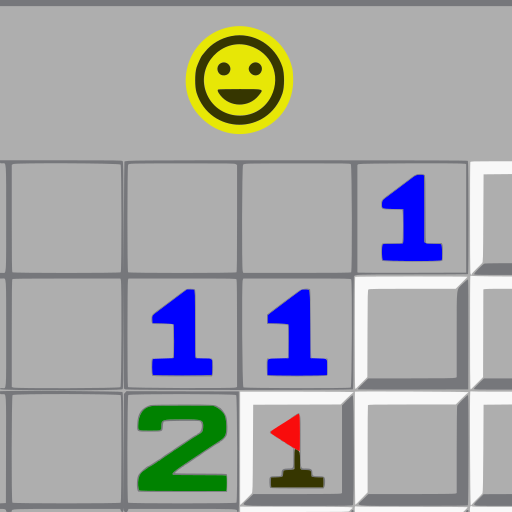
What MineSweeper is
MineSweeper is a one-player puzzle played on a grid of covered squares. Some squares hide mines and the rest are safe. You win by uncovering every safe square. Uncovering a mine ends the game on the spot.
Each safe square you open shows a number: how many of the squares touching it hold a mine. "Touching" includes diagonals, so a square in the middle of the board has eight neighbors, an edge square has five and a corner has three. A square that shows nothing has zero mines around it, so the game opens all its neighbors for you, and the empty area spreads until it hits numbers.
How to play
- Open a square. The very first move is the only real guess. After that, the numbers give you something to reason from.
- Read the numbers along the edge of the opened area. A 1 means exactly one of its covered neighbors is a mine, a 2 means exactly two, and so on.
- Put flags on squares you have proven are mines. A flag is a note to yourself and stops you from opening that square by accident.
- Open squares the numbers prove are safe. Each new number adds clues, so go back and recheck the numbers around it.
- Keep going until every safe square is open. You do not have to flag every mine to win.
Beginner tips
- Count covered neighbors first. If a number equals the number of covered squares touching it, all of them are mines. A 1 with a single covered neighbor gives you a mine for free.
- Then count flags. If a number already has as many flagged neighbors as its value, every other covered neighbor is safe to open.
- Start where the information is. Squares next to several numbers are easier to solve than squares floating in an unexplored region.
- Use the walls. Edges and corners have fewer neighbors, so their numbers are smaller and often resolve sooner.
- Flag only when you are certain. One wrong flag quietly poisons every deduction that relies on it.
Strategy to improve
Most boards fall to counting alone. When that stops working, look for patterns. They are all consequences of the same counting, just recognized at a glance.
Patterns worth memorizing
- 1-2-1 along a flat edge. Three revealed squares in a row reading 1, 2, 1, with covered squares in front of them: the two outer covered squares are mines and the middle one is safe.
- 1-2-2-1 along a flat edge. The two middle covered squares are mines and the two end squares are safe.
- The subset rule. If a 1 touches covered squares A and B, and a neighboring 2 touches A, B and C, then A and B hold exactly one mine between them, so C must be the second mine.
When you must guess
Some boards, especially dense ones, force a guess. Do not pick the nearest square. Compare your options: a square beside a 1 that has only two covered neighbors is a coin flip, while one beside a 1 with five covered neighbors is much safer. An untouched square far from any number carries roughly the board's average mine density, which is sometimes the best bet available.
If the version you play shows how many mines remain, check it near the end. Remaining mines against remaining covered squares can settle a last corner that the numbers alone cannot.
MineSweeper shares its pure-deduction feel with Sudoku, so if you enjoy one you will probably enjoy the other.
Common mistakes
- Guessing while a safe deduction exists. Scan the whole border of the opened area before you gamble.
- Flagging on a hunch. A flag should always be backed by a number.
- Forgetting diagonals. Missed diagonal neighbors are the most common counting error.
- Ignoring numbers that are already satisfied. A number whose flags are complete tells you the rest of its neighbors are safe. That is free progress.
- Rushing. On a touchscreen, a hurried tap on the wrong square is just as final as a wrong deduction.
Playing MineSweeper in Gaming Room
Controls
Tap a covered square to open it. Press and hold a square to place a flag, and press and hold again to remove it. There is no separate flag button, and a flagged square will not open when you tap it until you remove the flag. The yellow smiley at the top restarts the game, and the question-mark icon on the right shows a short help text.
Board size and mines
The ⋯ menu in the app bar offers seven sizes, written as columns by rows: 5x5, 5x10, 10x10, 10x15, 15x15, 15x20 and 20x20. A new game starts at 10x10. Each square has about a one-in-five chance of holding a mine, so the number of mines differs from game to game. The counter beside the flag icon shows the mines minus your flags and appears after your first move. If your first tap would land on a mine, the app builds a new board, so you never lose on move one.
Restarting or switching size while a game is in progress asks you to confirm giving up.
How a game ends
You win when every safe square is open. Flags are not required. If you open a mine, all remaining mines are revealed and wrongly placed flags are marked. A result screen follows, and its OK button appears after about five seconds. When you close it, a full-screen ad may appear.
Leaving and coming back
If you leave an unfinished game and return while the app is still open, it resumes where you stopped. Nothing is saved to your device: there are no high scores or history, and closing the app discards the game in progress.
Frequently asked questions
Is my first tap always safe in Gaming Room?
Yes. If your first tap would hit a mine, the app generates a fresh board until the square you chose is safe. It does not guarantee an empty opening, so the first square may show a number.
How do I place a flag in Gaming Room?
Press and hold a covered square. Press and hold it again to remove the flag. There is no flag-mode button, and a flagged square cannot be opened by tapping.
How many mines are on the board?
It varies. Each square has roughly a 20 percent chance of holding a mine, so a 10x10 board usually has about twenty. That is denser than the classic beginner and intermediate boards, so expect an occasional forced guess.
Do I need to flag every mine to win?
No. You win by opening all the safe squares. Flags are only a tool to help you keep track.
Can every board be solved by logic alone?
Not always. Random boards sometimes reach a point where every remaining move is a guess. When that happens, pick the square with the lowest chance of being a mine.
Written by Casa do Zéps and checked against the current version of the app. Game names such as Pacman, Tetris and Wordle are trademarks of their respective owners and are used here only to describe familiar kinds of game. Gaming Room is an independent app and is not affiliated with or endorsed by them.
 Pacman
 Tetris
 Sudoku
 2048
 Solitaire
 Peg Solitaire
 Labyrinth
 15-Puzzle
 Wordle
 Snake
 Memory Game