
What the game is
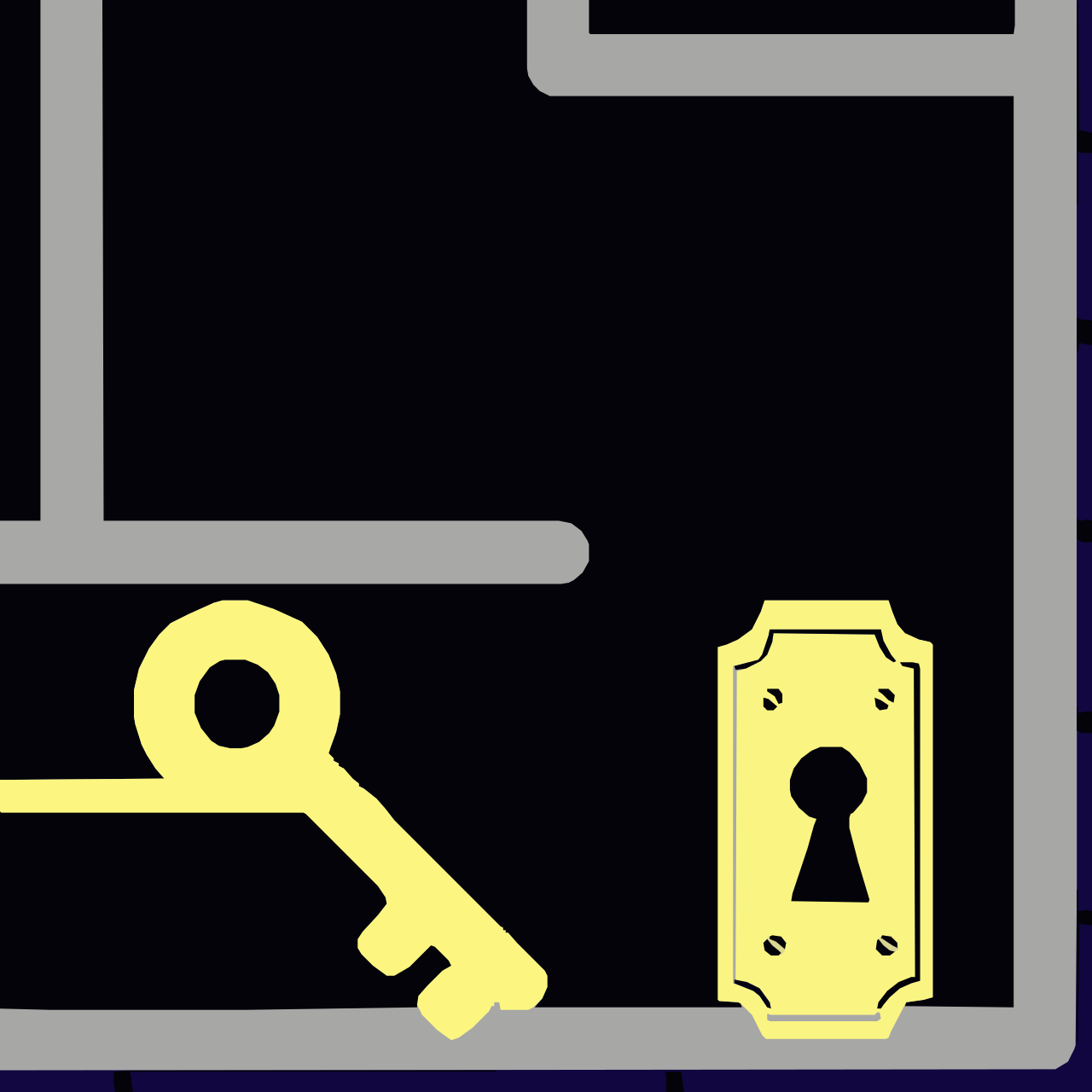
A labyrinth game gives you a grid of corridors, a starting point and an exit. Nothing is hidden and nothing chases you. The whole challenge is spatial: reading the layout, spotting dead ends before you commit to them, and remembering where you have already been.
Mazes come in two broad kinds. In a "perfect" maze, every cell can be reached and there is exactly one route between any two points, so there are no loops. In a braided maze there are loops and several possible routes. The difference matters, because some strategies are only safe in a maze without loops.
How to play
- Find your starting point and the exit. They are often in opposite corners.
- Before moving, spend a few seconds studying the picture. Follow the corridor that reaches the exit backwards with your eyes, as far as the first junction.
- Move one cell at a time along open corridors. Walls block you completely.
- At each junction, pick a branch. If it ends in a dead end, go back to the junction and try another branch.
- Keep going until you reach the exit.
Beginner tips
- Look before you move. A small maze can often be solved with your eyes alone, and the few seconds you spend scanning save many wrong turns.
- Start from the exit. The area around the exit usually offers very few options, so it is the easiest part to trace.
- Spot obvious dead ends. A corridor that narrows into a wall at the edge of the maze is not worth entering.
- Retreat early. When you hit a dead end, return to the last junction straight away instead of probing the walls around you.
- Move deliberately. On a touch screen, a sloppy drag can send you down the wrong corridor. A pause costs less than a detour.
Strategy to improve
Work backwards from the exit
Dead ends are effectively traps for someone walking forwards, so the route is often easier to see from the finish. Trace backwards from the exit until you hit a junction, then see which branch of that junction leads back toward the start.
Use the wall-follower rule
Imagine keeping one hand on the left wall and never lifting it. If the maze has no loops, you will eventually reach the exit, though it may take a long way round. It is a fallback for when you are lost, not a way to be fast.
Keep a trail
Whenever you reach a junction, note which branches you have already tried. If you can see your path drawn on the maze, use it: a branch you have fully explored and come back from is closed for good in a maze without loops, so never enter it twice.
Do not trust the straight line
If the exit is in the bottom-right corner, the instinct is to head down and right. In a maze the correct route often winds away from the exit before coming back to it. Judge each corridor by where it can lead, not by its direction.
Read the dead-end pockets
A dead end is rarely a single square. It is usually a whole pocket of corridors that all lead nowhere. If you see that every opening of a region leads back to the same entrance, treat the whole region as closed and skip it.
Scale up gradually
The strategies stay the same on a large maze, but the cost of a mistake grows. On bigger grids, break the maze into sections, such as the four quarters, and solve one section at a time.
Common mistakes
- Rushing down the first corridor without looking at the rest of the maze.
- Going back and forth between the same two junctions.
- Assuming the exit is reached by moving in its general direction.
- Applying the wall-follower rule to a maze that has loops, where it can circle forever.
- Not going back far enough after a dead end, then wandering in the same area.
- Pressing on when lost, instead of returning to the last junction where you had a choice.
If you like corridors and routes, you may also enjoy the maze-style boards in the Pacman guide.
Playing Labyrinth in Gaming Room
Controls
You play with your finger directly on the maze. You are a key that starts in the top-left corner, and the exit is a keyhole in the bottom-right corner. Start dragging up or down (the game reads vertical drags), then keep your finger moving where you want to go. Whenever your finger is more than one cell away from the key, the key takes one step toward it, along whichever axis the gap is larger. Walls stop you.
A trail shows the route you have walked. When you step back onto the previous cell, the last piece of trail disappears, so the trail always shows a path from the start to where you are, and dead ends vanish as you back out of them.
Sizes
The ⋯ menu in the app bar lists ten sizes, written as columns by rows: 5x5, 5x10, 10x5, 10x10, 10x15, 15x10, 15x15, 15x20, 20x15 and 20x20. The game starts at 5 columns by 10 rows. Choosing a size builds a new random maze right away, and if you are in the middle of one, the app asks you to confirm giving it up. Size is the only setting: there are no levels.
Finishing
Reaching the keyhole shows a "You win!" screen. Its OK button appears after about 5 seconds, and an interstitial ad may appear when you close it. The solved maze stays on screen until you pick a size or leave and come back.
Leaving and coming back
If you leave an unfinished maze and return while the app is still open, you resume in the same maze, at the same spot. Nothing is saved to the device: there are no high scores or score history, and closing the app discards your progress.
Frequently asked questions
Does every maze have a solution?
Yes. In Gaming Room every maze is generated at random with exactly one route from the start to the exit, so it can always be solved and there are no loops to circle in.
The key will not move. What am I doing wrong?
The key only steps when your finger is more than one cell away from it, so drag well past the key rather than touching next to it. Begin the drag by moving up or down, then steer in any direction.
Are there levels or difficulty settings?
No. Labyrinth has one setting: the maze size, chosen from the ⋯ menu, from 5x5 up to 20x20. Bigger mazes take longer and have more dead ends.
What is the best strategy for a big maze?
Study it first, work backwards from the exit to find the last junction, and treat any branch you have fully explored as closed. If you get lost, go back to the last junction where you had a choice.
Is my progress saved if I close the app?
No. An unfinished maze resumes if you leave the screen and come back while the app stays open, but nothing is stored on your device, so closing the app starts you fresh.
Written by Casa do Zéps and checked against the current version of the app. Game names such as Pacman, Tetris and Wordle are trademarks of their respective owners and are used here only to describe familiar kinds of game. Gaming Room is an independent app and is not affiliated with or endorsed by them.
 Pacman
 Tetris
 Sudoku
 2048
 MineSweeper
 Solitaire
 Peg Solitaire
 15-Puzzle
 Wordle
 Snake
 Memory Game